
A New Jersey consumer products company was sentenced this week to pay a criminal fine of $8 million plus an additional $395,786 in restitution to victims after pleading guilty to willfully failing to report dangerously defective air conditioners to the U.S. Consumer Product Safety Commission (CPSC). The case illustrates the staggering civil and even criminal consequences that can flow from failure to satisfy the Consumer Product Safety Act’s (CPSA) mandatory reporting requirements, especially the willingness of federal prosecutors to pursue criminal charges.
Continue Reading Criminal Sentencing in Royal Sovereign Case Underscores Staggering Consequences for Defective Product Reporting Failures
The Hidden Recall Risk in Your Licensing Agreement: What California’s Assembly Bill 2462 Could Mean for Your Business
A new bill introduced in the California legislature proposes to overhaul the state’s product recall liability framework—and depending on where you sit in the supply chain, the consequences could be far-reaching. Assembly Bill 2462 would amend the state’s Product Recall Safety and Protection Act to redefine who qualifies as a “manufacturer,” broaden the scope of cost-free recall obligations, and dramatically increase penalties for violations. Introduced by Assembly Member Pellerin on February 20, 2026, the bill’s provisions would apply across the consumer product supply chain, touching manufacturers, importers, distributors, wholesalers, retailers, and, most notably, brand licensors.
Continue Reading The Hidden Recall Risk in Your Licensing Agreement: What California’s Assembly Bill 2462 Could Mean for Your BusinessRegister Now! Between the Lines: What CPSC Enforcement Data Reveals for 2026 and Beyond

Register now to join Crowell & Moring for “Between the Lines: What CPSC Enforcement Data Reveals for 2026 and Beyond” to explore the latest regulatory enforcement trends and gain a forward-looking perspective on what 2026 and beyond may bring. The webinar will take place on Thursday, May 7, 2026 from 2:00 – 3:00 p.m. ET.
Continue Reading Register Now! Between the Lines: What CPSC Enforcement Data Reveals for 2026 and BeyondMaryland’s Artificial Intelligence Toy Safety Act: State-Level Regulation Fills the Federal Void on AI in Children’s Products

On February 12, 2026, a bipartisan group of legislators in Maryland proposed the Maryland Artificial Intelligence Toy Safety Act. This proposed legislation would amend the Maryland Consumer Protection Act to establish a sweeping regulatory framework for AI-enabled toys sold in the state, covering any device that uses machine learning, conversational AI, behavioral modeling, or similar computational processes and is marketed to or primarily used by children. This proposed legislation adds to a growing trend of increasing efforts, at both the federal and state levels, to regulate the use of AI in products and services used by children.
Continue Reading Maryland’s Artificial Intelligence Toy Safety Act: State-Level Regulation Fills the Federal Void on AI in Children’s ProductsDay 4 of the ICPHSO Symposium: Courtroom Drama & Consumer Voices

Day 4 marked the close of the ICPHSO 2026 Annual Meeting & Training Symposium in Orlando, Florida following a jam-packed week of education, exploration, and meaningful dialogue about the future of product safety and regulatory compliance in the U.S. and beyond. The day began with the traditional passing of the gavel to welcome incoming ICPHSO president Dani Cugini while acknowledging and celebrating the accomplishments of outgoing President Chris Harvey.
Then, in a first ever for ICPHSO, participants were thrust into the Courtroom for a mock-trial experience, giving many product safety professionals their first inside look at the complexities and challenges of litigating safety and products liability issues. Crowell’s “court reporter,” Sean Ward, was on the scene with a riveting recap of all the action. As court was called to recess, Day 4’s short program concluded with a series of plenary sessions highlighting the consumer perspective and the need for inclusive and proactive safety solutions that recognize the dynamic challenges faced by vulnerable populations and ensure accessibility to safety information for all.
Below is a closer look at select sessions from the final day of ICPHSO 2026.
Continue Reading Day 4 of the ICPHSO Symposium: Courtroom Drama & Consumer VoicesSecond Up to Bat at ICPHSO — and Swinging Hard: The New Realities of CPSC Enforcement
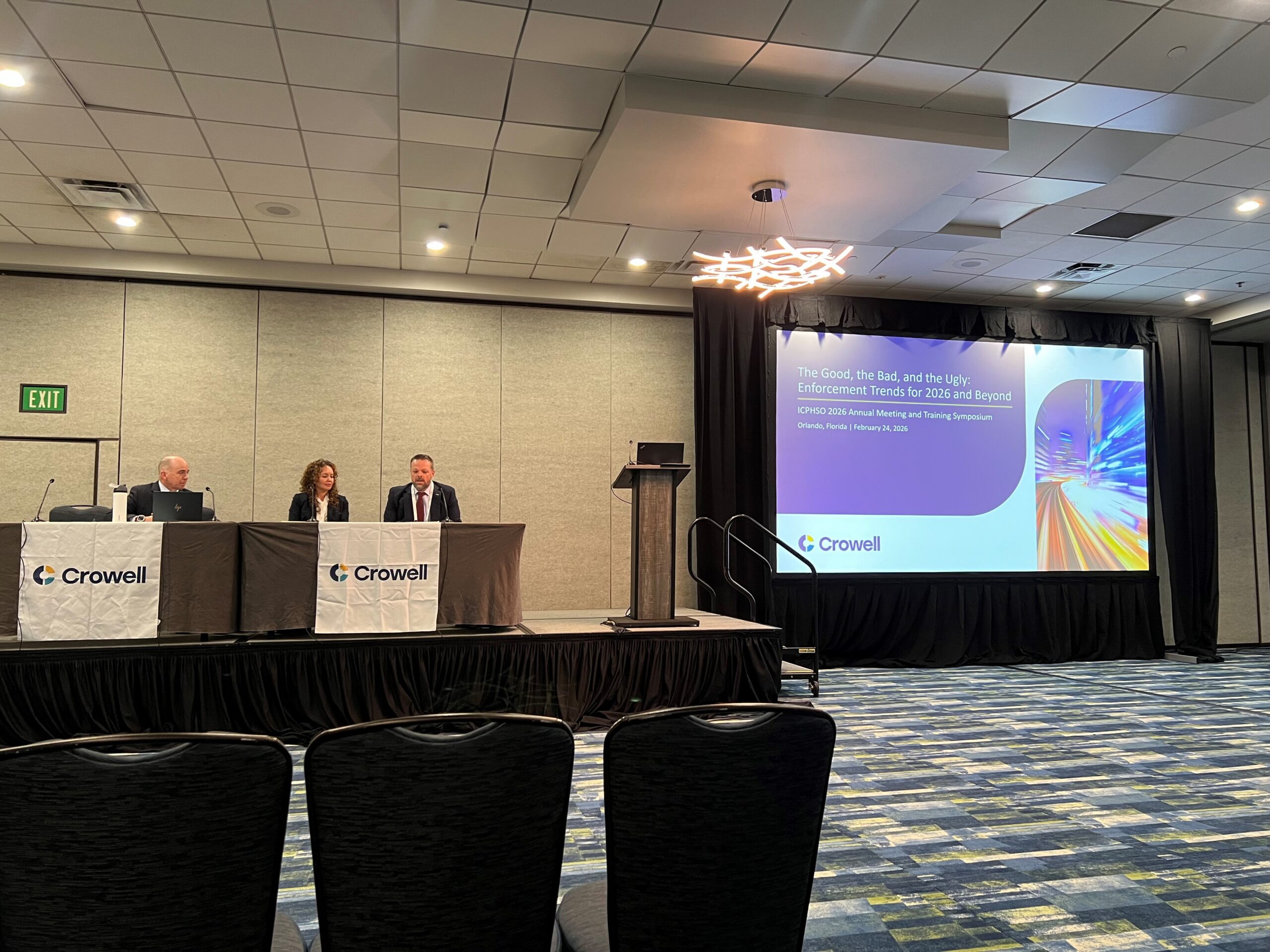
The second panel of the day brought a timely and clear-eyed look at where CPSC enforcement has been — and where it is headed. Crowell & Moring attorneys Clay Marquez, Chantel Greene, and Sean Ward started the second day of the ICPHSO Annual Meeting & Training Symposium walking attendees through the enforcement landscape using a framework as straightforward as it is memorable: the good, the bad, and the ugly.
Continue Reading Second Up to Bat at ICPHSO — and Swinging Hard: The New Realities of CPSC Enforcement2025 Recall Class Action Wave: False Advertising, Mislabeling, and Traceability Shape the Litigation Trends

The year 2025 saw an increase in recall class actions challenging false advertising, labeling, and recall remedies across consumer goods, from household products to pet food. One persistent question for courts in these recall cases is whether the plaintiff has Article III standing, which often hinges on “traceability.” These cases do not appear to be slowing down in 2026, as consumers are becoming even more conscious and selective about the products they purchase, driving greater scrutiny and risk for product companies across all industries.
Continue Reading 2025 Recall Class Action Wave: False Advertising, Mislabeling, and Traceability Shape the Litigation TrendsSCOTUS Tariff Decision: Implications for Retail and E-Commerce

The Supreme Court has concluded that the International Emergency Economic Powers Act (IEEPA) does not authorize President Trump to impose tariffs. Click here to continue reading the full version of this alert.
Playtime with AI? Senators Urge CPSC to Act

This past week, Senators Amy Klobuchar, Maria Cantwell and Edward Markey penned a letter to the Consumer Product Safety Commission (CPSC) with “concerns regarding the integration of artificial intelligence (AI) technologies into children’s toys.” The letter requests the CPSC respond by January 31, 2026 explaining how it will ensure children are protected from certain harms posed by AI.
Continue Reading Playtime with AI? Senators Urge CPSC to ActBeyond the Checkout: Retail’s 2026 Legal Minefield

2026 will be a significant year for retailers and e-commerce companies, with significant changes on the horizon that will affect the entire industry and ecosystem. In this alert, we highlight the top issues retailers and e-commerce companies should be aware of and ready to tackle in 2026. Click here to continue reading the full version