
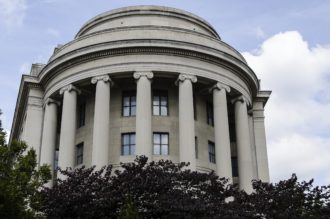
The Federal Trade Commission (FTC) closed out April and opened May with activity across both consumer protection and competition bureaus. This past week, the agency released new data showing the scale of social media-driven fraud, targeted allegedly deceptive multi-level marketing earnings claims, urged the Tennessee Supreme Court to reduce its reliance on ABA law school accreditation, and required divestitures to resolve competition concerns in a foodservice technology merger. More on these stories after the jump.
Monday, April 27, 2026
Bureau of Consumer Protection; Social Media; Advertising and Marketing
- The FTC released new Data Spotlight findings showing that social media was the costliest fraud contact method in 2025, with consumers reporting $2.1 billion in losses from scams that began on social media platforms—an eightfold increase since 2020. Nearly 30% of people who reported losing money to a scam said it started on social media, and reported losses tied to Facebook alone exceeded losses attributed to text and email scams combined. Investment scams accounted for the largest share of reported losses at $1.1 billion, while shopping scams were the most frequently reported, and romance scams also continued to feature prominently. The FTC emphasized that scammers use the same targeting tools and advertising infrastructure available to legitimate businesses, allowing them to tailor outreach based on consumers’ age, interests, and online activity.
Bureau of Consumer Protection; Online Advertising and Marketing; Earnings Claims
- The FTC took action against Steven and Gina Merritt, high-level participants in multilevel marketing company LifeWave, alleging that they used false or baseless earnings claims to recruit workers into the business opportunity. According to the complaint, the Merritts promoted LifeWave through videos and recruiting events with claims that participants could earn substantial income, including statements that recruits could make “$25,000 or more a week” and enjoy passive, ongoing income. The FTC alleged that these claims were contradicted by LifeWave’s own 2024 income disclosure, which showed that 79% of active participants earned no commissions and that only 0.035% earned more than $25,000 per week. Under the stipulated order filed in the U.S. District Court for the Southern District of Florida, the Merritts are prohibited from misrepresenting participant earnings or other material facts about a business opportunity, and they may not make earnings claims unless those claims are truthful, substantiated in writing, and supported with evidence available to prospective recruits on request. They also must notify their downline participants about the FTC’s allegations and the order’s restrictions.
Friday, May 1, 2026
Office of Policy Planning; Bureau of Competition; Accreditation and Occupational Licensing
- FTC staff, joined by the Department of Justice’s Antitrust Division and the U.S. Attorney for the Middle District of Tennessee, urged the Tennessee Supreme Court to reduce or eliminate its reliance on the ABA in determining which law schools qualify graduates to sit for the Tennessee bar exam. In its comment letter, the FTC argued that reliance on ABA accreditation imposes an elitist model of legal education. The letter framed the issue as one of competition policy, contending the current model drives up the cost of legal education and limits the supply of lawyers, which serves the anticompetitive interests of the lawyers who dominate the ABA membership, while undermining the interests of consumers seeking affordable legal services. Citing similar recent moves in Florida and Texas, the FTC encouraged Tennessee and other states to open accreditation to greater competition.
Bureau of Competition; Merger Enforcement
- The FTC announced a proposed consent order requiring 365 Retail Markets LLC to divest Cantaloupe’s Three Square Market business as a condition of completing its $848 million acquisition of Cantaloupe Inc. According to the FTC, the transaction as originally structured would combine the two largest providers of micromarket kiosks—small unattended convenience stores often found in offices and breakrooms—as well as related software and services, eliminating direct competition and likely leading to higher prices and reduced quality. The complaint also alleged that the deal would give 365 Retail, which is controlled by Garage Topco LP, the ability and incentive to foreclose rivals by limiting interoperability between its kiosks and competitors’ software, potentially raising costs for foodservice operators and, in turn, food prices for consumers. Under the proposed order, Three Square Market will be divested to Seaga Manufacturing Inc., which the FTC views as positioned to become a viable standalone competitor. The order also requires 365 Retail to offer software and hardware integrations on reasonable and non-discriminatory terms, appoints a monitor to oversee compliance, and imposes a 10-year prior notice requirement for future U.S. micromarket kiosk acquisitions. The Commission voted 2-0 to issue the complaint and accept the consent agreement for public comment.